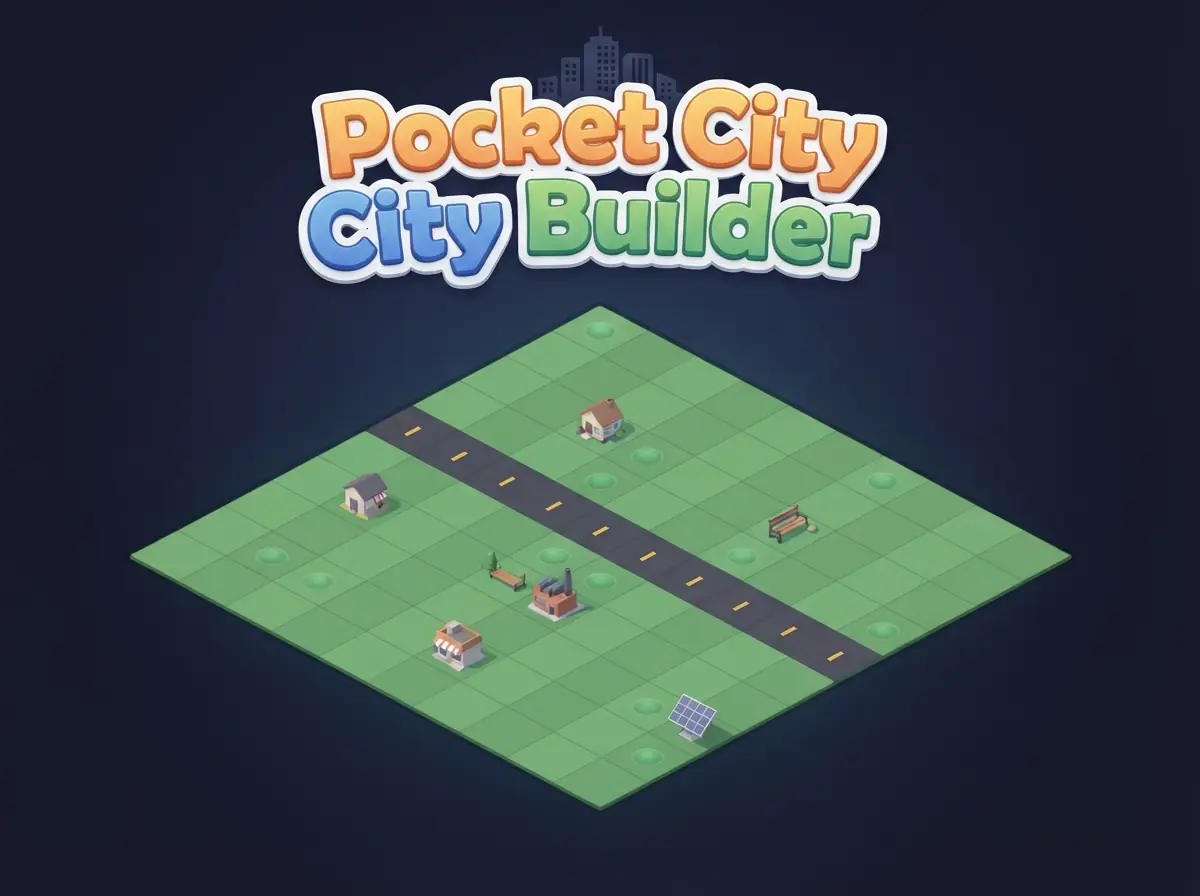
Pocket City Builder Strategy: Grow a Happy City
Power, jobs, parks and roads all pull in different directions. Learn how Pocket City Builder's economy works and follow a simple plan for a bigger city.

Pocket City Builder gives you a small 10 by 10 map, $600 and 40 days. Each day passes in a couple of seconds, so a whole game takes well under two minutes. Short as it is, every building changes your money, power and happiness at the same time, and early mistakes are hard to undo.
This guide explains the rules that drive the simulation and turns them into a plan you can follow from day one.
How the city works
Everything in Pocket City Builder comes back to four numbers shown next to the map: homes, jobs, power and daily income.
- Houses ($100) give room for 8 residents and use 1 power.
- Shops ($150) create 6 jobs, use 1 power and make residents a little happier.
- Factories ($250) create 12 jobs and use 2 power, but their noise lowers happiness.
- Power plants ($300) supply 12 power and lower happiness slightly.
- Parks ($80) raise happiness, and raise it more for every house directly beside them.
- Roads ($10) connect everything.
The most important rule is easy to miss: a building only works if it touches a road on one of its four sides. Diagonal does not count. The game highlights buildings that are not connected, and until they are, they add no homes, jobs or power. Parks are the one exception and work anywhere.
Where the money comes from
Every day you collect taxes and pay upkeep. Each resident pays a small amount, and each resident with a job pays a lot more. Upkeep is charged on every built tile, roads included.
So employed residents are the engine of your economy. A city full of houses and no jobs barely pays for itself, while a balanced city earns more every day. If the Daily figure turns red, stop building homes and add jobs.
Watch the bottom line too. If your treasury falls below minus $300, the city goes bankrupt and the game ends early.
Power: never run short
Power shortages are the most expensive mistake in the game. If your buildings need more power than your plants supply, happiness drops sharply and your tax income is cut in half until you fix it, while upkeep stays the same.
Keep an eye on the Power figure, which shows demand against supply. Build your next plant before you reach the limit, not after. One plant covers 12 houses, or a mix of 6 houses and 3 factories, so it lasts longer than you might expect.
Happiness controls growth
Your population changes once a day, and happiness decides by how much:
- 60% or more: the city grows by 4 residents a day.
- 40% to 59%: it grows by 2 a day.
- Below 40%: people move away.
Residents also need somewhere to live, so the population can never be higher than your housing allows.
Since growth is capped at a few residents a day, time spent below 60% happiness is gone for good. A city that is happy from the first few days has a large head start over one that fixes its happiness at day 20.
These things push happiness up or down:
- Shops and parks raise it. A park with houses on several sides is the best value in the game.
- Trees help a little. They are worth keeping, and bulldozing one costs $5.
- Factories and power plants lower it.
- Unemployment lowers it: every resident without a job drags happiness down a bit.
- A power shortage lowers it a lot.
A simple opening
The starting road already runs right across the map. Before building any new road, use the plots along both sides of it. That saves money twice: no road costs and no extra road upkeep.
A solid first move is a power plant, a house and a shop, all touching the starting road, for $550. You get power, homes and jobs at once, without falling into a shortage.
Over the next days, add buildings in this rough order as money allows:
- A park placed between houses, to push happiness comfortably above 60%.
- More houses, so you always have a little spare room for the next residents.
- Shops whenever jobs fall behind the number of residents.
- A factory once happiness has some room to spare, because it adds a lot of jobs at once.
Pause the game with P or Esc whenever you need a moment to plan. The days stop while you think.
Mid-game checklist
Every few days, check the four numbers next to the map:
- Homes nearly full? Build a house before growth stalls.
- Jobs lower than residents? Add a shop, or a factory if happiness can take it.
- Power demand close to supply? Save up for the next plant now.
- Daily income negative? Stop building homes and add jobs first.
If a building is in the wrong place, the bulldozer refunds half its cost. It is often worth moving a park next to more houses.
How the final score works
When day 40 ends, your score adds up population, money in the bank and happiness. Population counts the most: one extra resident is worth more than $20 left over. Spending money on growth is almost always better than saving it.
There are milestones too. Reaching 40 residents makes your settlement a Village, which counts as a successful game, and 120 makes it a Town. Getting to Town means keeping happiness at 60% or more for most of the 40 days, which is why the opening matters so much.
Final thoughts
Pocket City Builder is a puzzle about balance. Build along the road you already have, keep the power on, match jobs to residents and protect happiness from day one. If you enjoy planning ahead, the same mindset helps in Kingdom Tower Defense, where every coin spent early shapes the waves to come.